

“We’re changing property investor tax breaks to give first home buyers a fair go.”
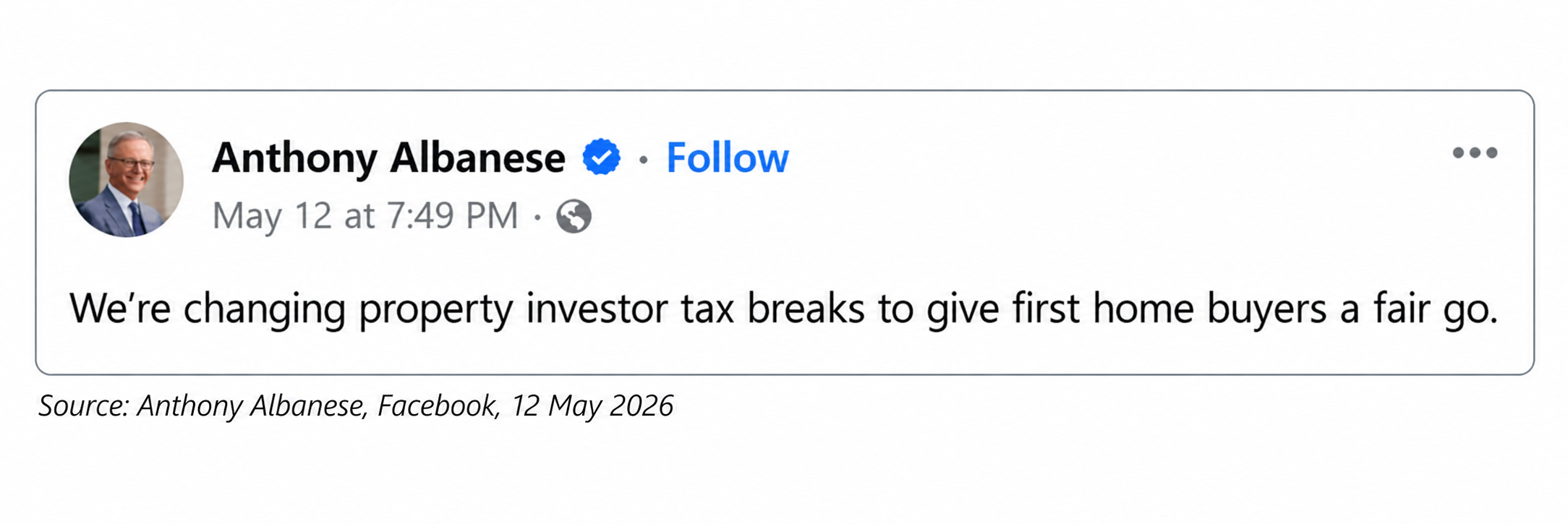
Those are Anthony Albanese’s own words, posted on budget night.
I want to take him at his word. I really do. But I have some questions.
My story
I bought my first investment property when I was 24. I sold it five years later, upgraded, and became an owner occupier at 29. That property changed my life financially.
I could not have bought it without negative gearing. And I could not have sold it without the capital gains tax discount making the return worthwhile.
If this budget had been passed 30 years ago, I would not be in the financial position I am today.
The Prime Minister says this budget gives young Australians a fair go. I’m not convinced.
The ladder has been pulled up
Negative gearing still exists. But only for new builds.
That sounds reasonable. Until you think about it.
New builds are a bit like buying a brand new car. You pay a premium for the shiny finishes. But the moment you drive it out of the showroom, the value drops. A few months of wear and tear and those finishes aren’t so shiny any more. Neither is the price you could sell it for.
Experienced property investors know this. New builds rarely deliver the best returns. That is why savvy investors buy established properties.
So the Government is saying this: you can have the tax concession. But only on the asset class that experienced investors tend to avoid.
It’s not a level playing field. It’s a consolation prize.
And who benefits from the existing concessions? Those who already have equity, borrowing power and established portfolios. Not the 24 year old trying to get a foothold.
I am not the only one who thinks this.

Source: Tina, Facebook, 13 May 2026
She is right. The rules have not been levelled. They have been rewritten to favour those who are already ahead.
And it’s not just property. Young Australians who turned to shares and ETFs to build wealth are being hit too. The budget introduces a 30 per cent minimum tax on capital gains across the board. Every pathway younger Australians were using to get ahead is now harder.
Priya put it simply.
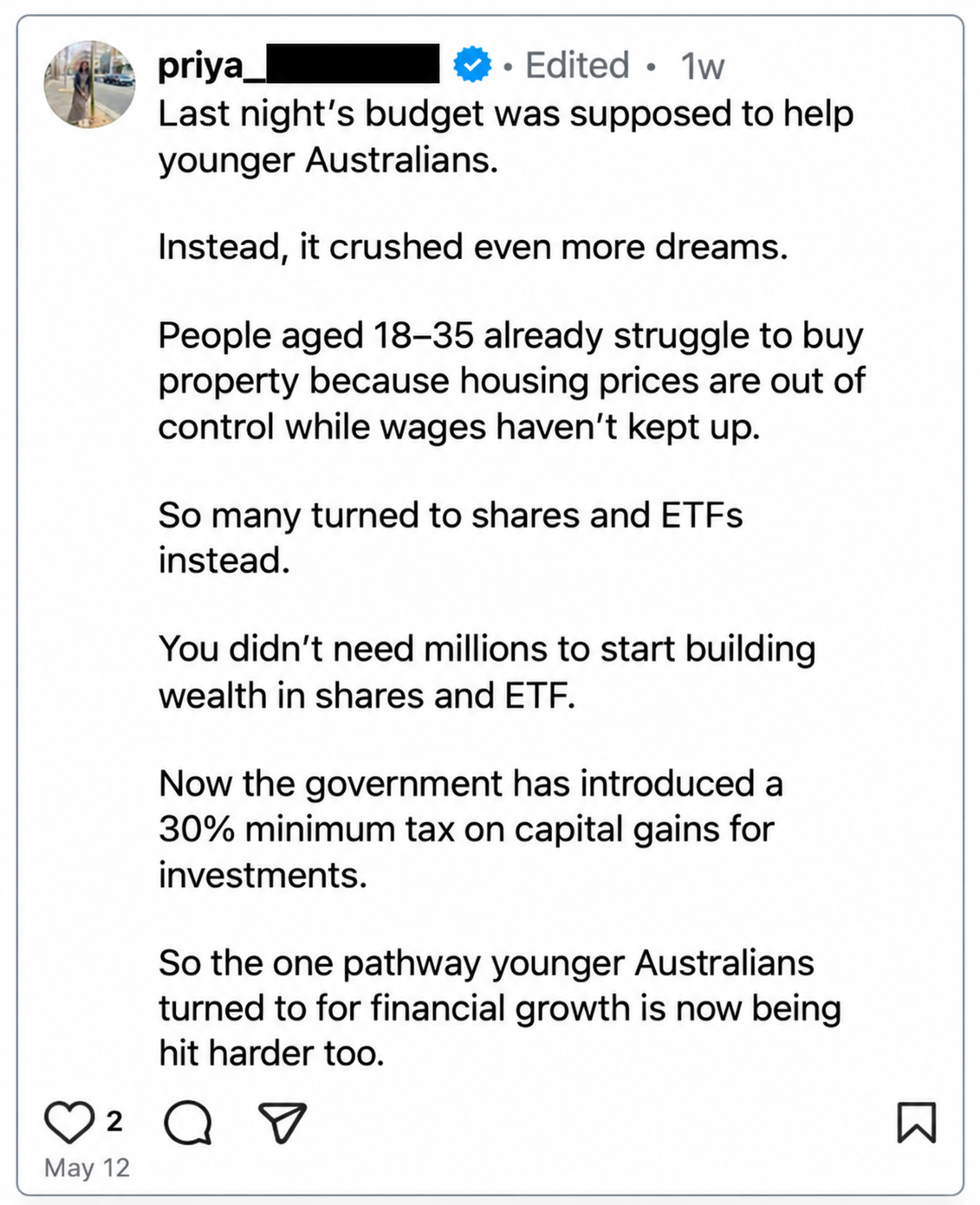
Source: priya, Instagram, 12 May 2026
Where is the supply going to come from?
The government says this budget is about affordability. But there is only one reliable way to make housing more affordable. Build more of it. More supply means more choice and lower prices. Less supply means the opposite. You don’t need to be a Price Wizard to understand that.
So here is the question nobody is answering. Where is the extra housing going to come from?
Start with investors. When you reduce the tax incentives for buying established properties, investors leave the market. That is not a prediction. It is basic human behaviour. People invest where the returns are best.
When investors leave, capital dries up. First home buyers will replace some of that capital. But not all of it. First home buyers have smaller deposits, tighter borrowing capacity and less appetite for risk than experienced investors. The gap they leave behind is real.
The Housing Industry Association’s independent modelling puts a number on this. It found that restricting negative gearing to new builds could reduce dwelling commencements by around 22,700 over five years. That is 22,700 homes that would have been built and won’t be. That is 22,700 fewer properties available to tenants. And that is before you factor in the broader chilling effect on developer confidence.
Australia is already building well short of what it needs. We were short 65,000 homes last year alone against the National Housing Accord target. This policy makes that problem worse, not better.
Treasury says rents will rise by less than $2 per week. I am an actuary. I have spent my career building forecasts. And I know this about models: if you want a particular answer, you can usually find a way to get one. When a government model produces a number that convenient in a market this uncertain, I get very nervous.
The people it was designed to help don’t believe it
Here is what struck me most after budget night. The very people this policy is supposed to help are not convinced it will work.
Sharon is not a wealthy speculator. She worked hard her whole life, sold a business, and had a clear plan to buy an investment property in a regional town that genuinely needs more housing. Budget night changed that.
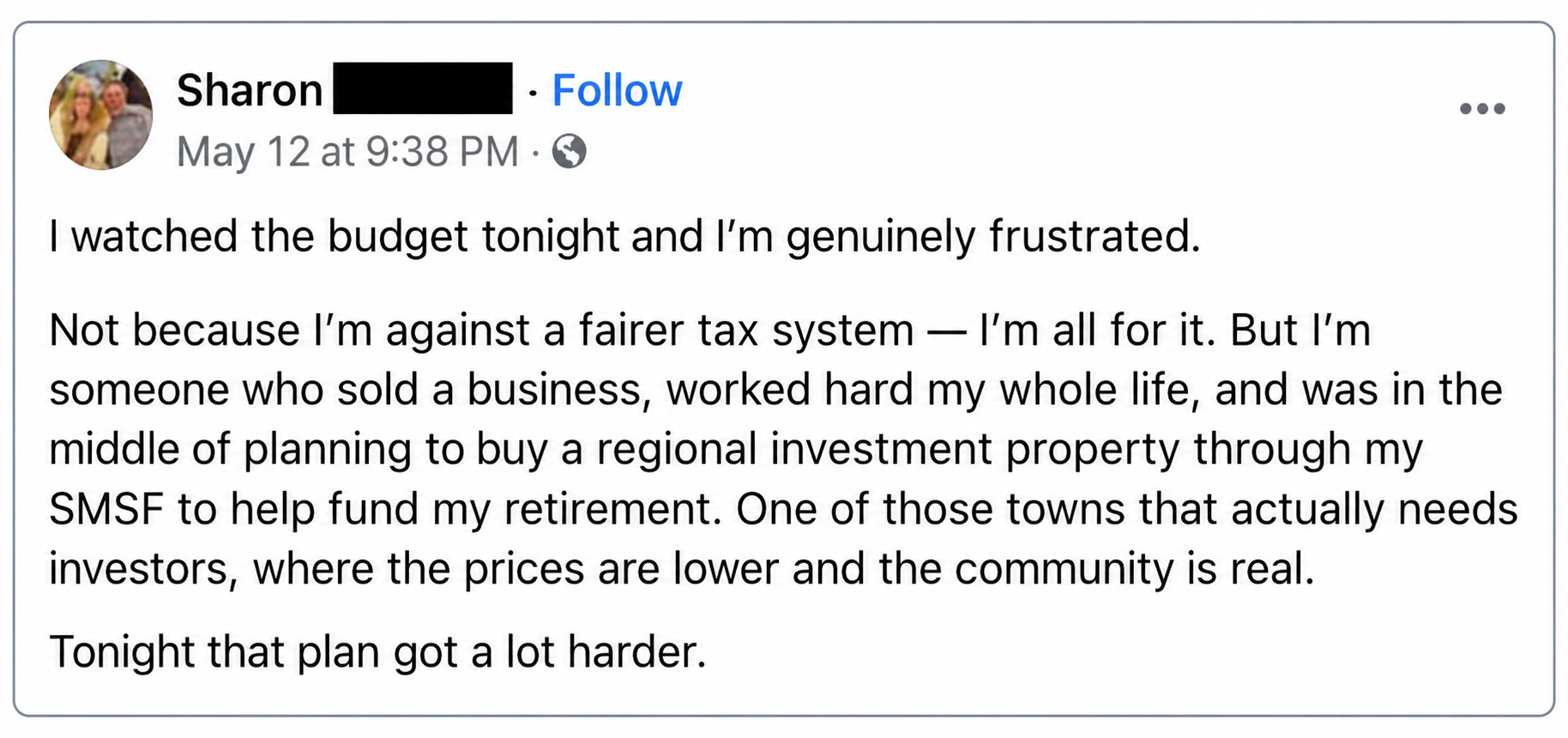
Source: Sharon Law, Facebook, 12 May 2026
She is exactly the kind of investor the market needs. Not the kind the government should be driving away.
So what happens to rents?
Honestly. Nobody knows.
We have conflicting forecasts from credible sources. We have an untried and untested policy. And we have a rental market already under serious pressure, with vacancy rates near historic lows and rents up 30 to 40 per cent in many cities since 2021.
What we do know is this. Yesterday’s rent is not a reliable guide to tomorrow’s rent.
The market will move. It always does. The signals are already shifting.
The operators who navigate this best will be the ones who treat rent setting as a science, not a guess. Accurate forecasting in a volatile market is not a nice to have. It is a competitive necessity.
If ever there was a moment for scientific pricing, it is now.